
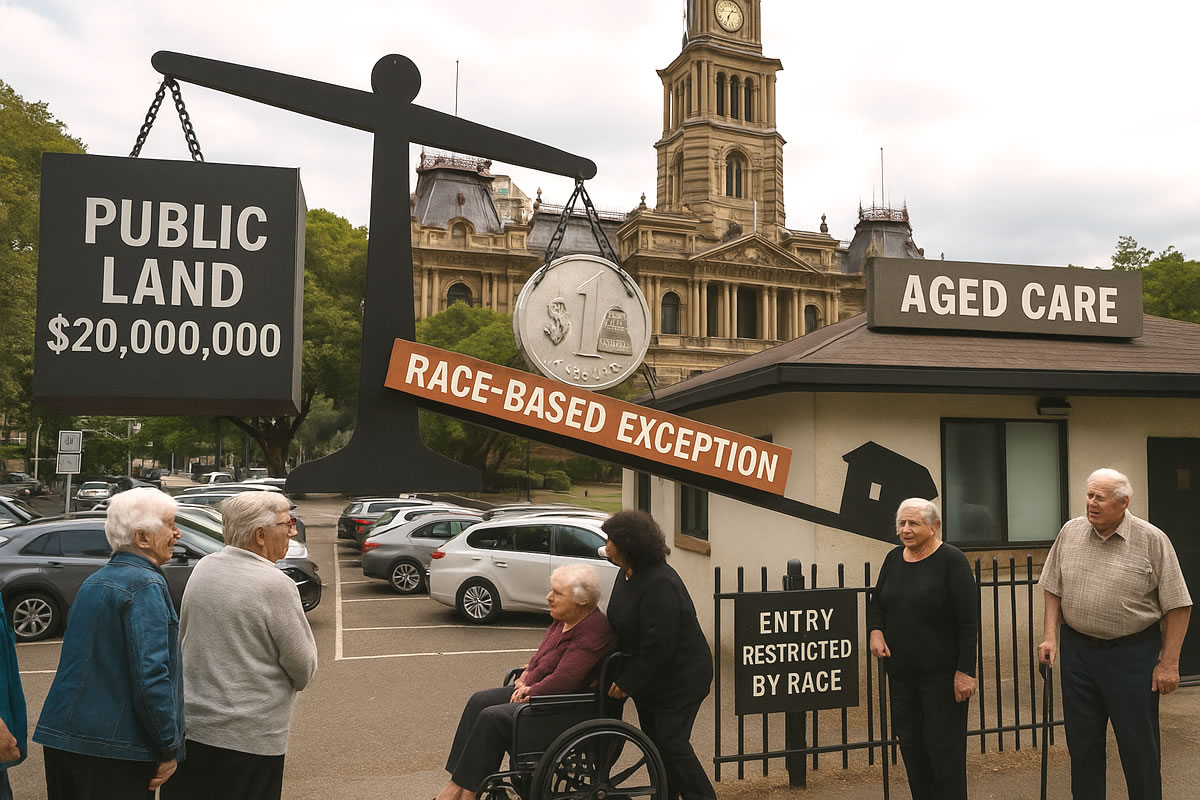
Sydney’s Redfern is no stranger to political symbolism, but the City of Sydney’s decision to grant a council-owned car park valued at roughly $20 million to Wyanga Aboriginal Aged Care for the nominal fee of one dollar has elevated symbolism into policy with far-reaching consequences for equality under the law, public transparency, and the long-term cohesion of our civic life. According to the council’s own documentation and contemporary reporting, the site at 49 Cope Street—presently a 55-space public car park—is to be converted into a 50-bed residential aged-care facility expressly for Aboriginal and Torres Strait Islander elders, with the land effectively gifted to the Indigenous provider and its development partner on terms that would make any private bidder blush. The basic facts are these: the City of Sydney endorsed the transfer for $1, with an encumbrance intended to keep the land dedicated to aged care “in perpetuity,” while the car-parking capacity is to be re-provided in an underground stratum also transferred back to council for $1 upon completion. This is no rumour; it is recorded in council papers and amplified proudly by media briefings and social posts heralding the decision as an exemplar of “culturally safe care” and “self-determination” in action.
The urge to present this as a costless social good is powerful. City officials and allied advocates assert that the transfer is a compassionate deployment of a public asset for a vulnerable cohort in dire need of appropriate care. To the uncritical eye, that premise sounds unimpeachable, and no one of good faith should deny that many Indigenous elders carry a unique burden of historical trauma, poorer health outcomes, and mistrust of institutional settings. Yet the integrity of a liberal society is not measured by sentiment alone; it is measured by the consistent application of principle. Australia’s social contract is built on a promise of equality before the law, of universal public services delivered on the basis of need rather than lineage, and of a shared civic identity that transcends the accident of birth. When a council disposes of a multimillion-dollar public asset at a token price to establish an Indigenous-only residential service, it is not merely building a facility; it is building a precedent that normalises the distribution of public goods along racial lines. That precedent cuts against the grain of national unity and undermines trust in the fairness of our institutions.
The political framing around this Redfern decision is as telling as the transaction itself. Proponents repeatedly invoke “cultural safety”—a term that now does heavy ideological lifting across government and the not-for-profit sector—to claim that mainstream aged-care providers are inherently ill-equipped to care for Indigenous elders and that separate, Indigenous-controlled environments are the only remedy. The council’s communications emphasise that the one-dollar conveyance is a pragmatic way to unlock a service that the market will not otherwise provide; advocates add that the model is community-empowering and restorative. Taken at face value, each line has a veneer of reasonableness. But treat “cultural safety” as a policy trump card and you swiftly arrive at a system where race is destiny for service design, access, and, critically, ownership of the public realm. It is one thing to fund tailored programs within a universal system; it is quite another to convert the tangible property of the public into a permanent enclave for a single identity group. The difference matters, because property is power—and gifting property on racial terms teaches citizens to think like racial claimants.
The literature on reconciliation, particularly its institutionalisation inside government, tends to justify departures from liberal equality by appealing to historical exceptionalism: the harms of dispossession warrant present-day “structural” carve-outs. The Redfern giveaway must be read through that lens, and the timing is not incidental. After a year-long national debate culminating in the referendum defeat of the Voice proposal, elites have pressed on with sub-constitutional workarounds: procurement preferences, grant programs, bespoke governance boards, and, now, the transfer of public land at peppercorn prices to Indigenous-only operators. To the extent this is sold as “self-determination,” we should be frank about what it is and what it is not. It is not market exchange; it is not a competitive tender ending in the highest public benefit measured across all citizens. It is a political judgment that the identity of the beneficiary is itself a public benefit that overrides equal access to public assets. That judgment is the very engine of identity politics, and it is in tension with the classical liberal settlement that built our prosperity.
Defenders of the council will counter that the land is not being “lost” to the public because an aged-care home is a public good, the car-park spaces will be re-provided underground, and restrictions on title guarantee perpetuity of use. They will add that Wyanga has for decades served Indigenous elders with home-care programs next door and that scale and continuity justify a purpose-built residential facility. They will note that Uniting—an established not-for-profit—will partner in the project, suggesting probity and operational competence. To that, one must respond with questions that a serious press and a vigilant citizenry should always ask. Where is the cost-benefit analysis comparing this land transfer to alternative uses, including the sale of the site at full market value and the redirection of proceeds across the city’s aged-care system irrespective of race? Where is the transparent accounting on opportunity cost—what public amenities are foregone when a $20 million site is removed from general circulation and placed in a racially exclusive trust? What mechanisms, beyond a restrictive covenant, will ensure continuing public accountability for a private operator installed by favour rather than competitive auction? And the hardest question: under what legal and moral theory does a democratic council tell non-Indigenous ratepayers that a public facility is reserved by birthright for someone else?
One can accept, fully and without defensiveness, that there are cultural competencies crucial to caring for Indigenous elders. It does not follow that the only way to achieve that is to segregate residential aged care by race and to transfer public real estate to achieve it. True reconciliation—if that term is to have any meaning beyond slogans—must be reconciliation to a shared civic future. That requires an ethic of inclusion wherein mainstream services lift their game, integrate culturally informed practice, and recruit Indigenous Australians into leadership and frontline roles, not an ethic of partition where every perceived cultural nuance is grounds for a parallel institutional system. If we are serious about dignity in care, we should be serious about universal dignity first, and tailored dignity second. The inversion now on display elevates identity above universality and, in the process, writes division into the city plan.
It is difficult to ignore the political character of the City of Sydney’s current leadership. The posture of the Lord Mayor’s office has long been to treat the council’s remit as a pulpit for moral instruction—on climate, on transport, on speech norms, and, increasingly, on identity. Residents have grown accustomed to seeing sweeping social agendas layered onto zoning decisions and service redesigns. Announcements are often framed as moral progress, and dissent is treated as moral regression. When council declares a car park is now an Indigenous-only aged-care home because “cultural safety” demands it and because elders deserve a “home on Country,” the rhetorical force aims to end debate, not invite it. But citizens do not owe their council deference. They owe their elders—of every background—care that is excellent, fair, and accountable. They owe each other a commitment to a single civic standard, not a warren of special passes.
The defenders will say this reading is uncharitable. They will remind us that council ran an expression-of-interest process, that Uniting and Wyanga submitted a credible plan, and that conditions were attached to protect the public interest including the return of parking strata and use-in-perpetuity restrictions. All true and yet insufficient. An EOI led by a council philosophically invested in identity carve-outs is not a market test of ideas; it is a funnel engineered to deliver a preferred ideological outcome. Use-in-perpetuity clauses are cold comfort when the perpetuity being guaranteed is not “aged care for all,” but “aged care for some.” The return of a car-park stratum is likewise beside the point. The core of the transaction is the permanent conversion of a democratic asset into a racially bounded domain. It asks the public to accept that certain services, spaces, and benefits properly belong to identity constituencies and that our collective role is to become a federation of lobbies carving out territory. That is not a recipe for harmony; it is a map for quiet resentment and future conflict.
Those who worry about “division” are often mocked as alarmists. But division is not a feeling; it is a policy architecture. Build enough race-first institutions and you will get a race-first politics. You will get funding battles no longer about need and performance but about whose ancestors suffered more and whose identity scores highest on the intersectional leaderboard. You will get hiring mandates that subtly replace competence with compliance, and you will corrode the trust that makes citizens willing to fund each other’s needs. In aged care, the stakes are intimate. Australians should want their parents and grandparents to be housed and cared for in environments that are safe, loving, and culturally literate. They should not have to present a racial passport at the door. A system that begins to normalise such passports—even if only informally at first—should trouble anyone who believes Australia is a nation and not a loose confederation of tribes.
Our editorial stance at Welcome To Australia is no secret: we reject DEI bureaucratese that treats race and identity as master keys to the public treasury. We believe in freedom of thought, equality under the law, and a robust meritocracy where resources track demonstrable need and performance. Apply those principles to Redfern and the path forward clarifies. If the site is truly the highest-and-best location for a 50-bed aged-care facility, then let a proper market contest determine who builds and runs it under transparent, universal service obligations that include cultural standards for every resident, Indigenous and non-Indigenous alike. If Wyanga and Uniting are the best operators on capability and outcomes—as they might be—then let them win a competitive lease on that basis, not a gift on identity grounds. If the principle is that Indigenous-controlled providers best serve Indigenous elders, then fund services on a per-resident basis and tie the funding to outcomes, not to land transfers. And if the principle is that the city’s assets belong equally to all who fund them, then preserve that principle in every conveyance. The dollar price is symbolic; the real price is the one paid in public trust.
Critics will protest that market models ignore the scars of history and the realities of cultural need. That assertion is an excuse for indolence. We do not live in 1905; we live in a country with a sophisticated regulatory and accreditation regime, a plural healthcare workforce, and social expectations that relentlessly punish overt prejudice. If mainstream providers fail to achieve cultural competence, reform them. If staff diversity lags, recruit and train. If clinical models are insensitive, redesign them. It is the work of a serious society to improve universal systems, not to abandon them in favor of parallel ones. The easy route—grant land on identity grounds and declare victory—satisfies an activist cycle and buys temporary applause, but it leaves the hard work undone and shifts costs and division onto the next generation.
The moral temptation to right past wrongs with present carve-outs is not new, and it rarely ends well. The United States flirted with similar models under the banner of affirmative action and is now unwinding them under constitutional challenge and public fatigue. South Africa’s BEE policies have entrenched a politically connected elite without lifting millions. Everywhere the experiment is tried, the lesson repeats: you cannot engineer solidarity by allocating goods by tribe; you can only paper over tension until the bill arrives. Australia should learn from those cases rather than repeat them with a narrow local gloss. The Redfern giveaway is not a one-off; it is part of a proliferating ecosystem—procurement preferences, identity-based grants, racial set-asides in hiring—that quietly reorganises the public realm around categories many of us hoped we were leaving behind.
There is a path back to sanity, and it begins with honest language. Calling a racially exclusive facility “culturally safe” does not make it universal; calling a land gift “self-determination” does not make it fair. We can acknowledge the beauty and dignity of Indigenous cultures, and the legitimacy of Indigenous institutions, without conceding that the public sphere must be sliced by ancestry. We can fund Indigenous-led services because they meet documented needs superbly, not because they are Indigenous per se. We can celebrate elders without walling them off. And we can demand that public officials justify every disposal of public land with a rigorous demonstration that no alternative—not one—would better serve all citizens and uphold the standards we owe each other.
Consider the optics and the message to the young. A generation raised to believe that identity is power watches as government converts that thesis into brick and mortar—and learns to game it. They internalise the logic that they are representatives of a category first and citizens second. The next time a council seat or a grant or a development site becomes available, they will not ask, “How can I best serve my city?” They will ask, “Which category has leverage?” That is a kind of education, but it is not civic education. It is the slow unpicking of a nation.
The City of Sydney’s defenders may finally retreat to pragmatism: the need is urgent; the site was available; the deal got done. But urgent needs do not justify lazy standards, and political availability is not the same as legitimacy. If the council wanted an Indigenous-led operator to run a truly excellent residential home in Redfern, it could have leased the site on public-value terms, insisted on universal access, embedded cultural-safety benchmarks in the service agreement, and audited outcomes ruthlessly. It could have set a standard that said to every provider: meet these benchmarks and you will win public business; fail and you will lose it. Instead it set a different standard that says to the city: race opens doors that remain closed to others. And once you open that door, you will find it very hard to close.
The Redfern decision is not the end of Australia as a liberal democracy. But it is a step in the wrong direction taken with public fanfare that discourages dissent. It is the kind of step that multiplies if not checked by citizen scrutiny. Ratepayers have the right—and the duty—to demand explanations grounded in universal principle. They can insist on open tenders, on independent valuations, on outcome-based contracts, and on facilities that welcome everyone while delivering superb, culturally literate care to anyone who needs it. They can defend a vision of reconciliation that reconciles people to one another, not to their silos. They can show that real national unity is not performative but practical: equal rules, equal dignity, equal responsibility.
For the record, none of this requires denying the excellence or goodwill of Wyanga or Uniting. They may well build and operate a facility that delivers humane, culturally rich care and becomes a model for others. If they do, they deserve recognition. But they should never have been placed in possession of a public asset on racial terms. The public square must remain public. If we want to avoid the hardening of resentment that corrodes democracies from within, we must treat identity politics not as compassion but as temptation—and we must decline it.
Sydney can be a city of generosity without being a city of carve-outs. It can be a city that honours Indigenous elders without telling non-Indigenous elders that public doors are not for them. It can be a city that proves universalism is not colour-blindness but equal-sightedness: the ability to see cultural need clearly while refusing to grant it unlimited veto power over principle. The Redfern land transfer fails that test. It is now up to citizens—of every background—to demand that their council meet it.
To those who think this is a storm in a teacup, consider the precedent. If $20 million in public land can be conveyed for a dollar to build a race-exclusive facility, what stops the next body from conveying the next asset for the next identity claim? If every decision is framed as a test of moral loyalty to a cause, who will police the boundaries of fairness? The answer, as always in a democracy, is you. Demand equal rules. Demand transparent process. Demand universal service. And do not be cowed by slogans masquerading as policy. Australia is strongest when we remember that what binds us is not the box we tick but the duty we share. On that foundation, aged care for every elder—delivered with excellence and cultural intelligence—becomes not only possible but inevitable. Anything less is not compassion; it is abdication.
Meta Description: Sydney Council’s $20 million Redfern car-park site has been awarded to an Indigenous-only aged-care provider for $1, igniting a national debate about racial preferences, “cultural safety,” reconciliation that divides, equality under the law, and the future of Australian unity.